

%20(1).png)
The Industry Is Just Catching On. Lahlouh Has Been Here for Decades.
There's a shift happening in the world of print and promotional products — and the industry is finally putting a name to it.
At this year's PRINTING United Expo, the Advertising Specialty Institute (ASI) is debuting a dedicated ASI Show Pavilion inside one of the largest printing events in the world.1 The message is clear: print and promo are no longer separate conversations. End buyers want integrated campaigns. They want branding, signage, merchandise, packaging, and fulfillment from partners who understand how all of it connects — and can execute it without making them manage five different vendor relationships to get there.
This convergence is real. And it matters. But here at Lahlouh, it's nothing new.
We've been in print for 45 years. We've been in branded merchandise for 30. And for as long as we can remember, our most successful clients have been the ones who stopped treating these as separate line items and started thinking about them as one integrated strategy.
So let's talk about why that matters — and what it actually looks like in practice.
The Real Cost of Running It Through Five Different Vendors
When a campaign gets split across multiple vendors — one for print, one for promo, one for kitting, another for fulfillment — the friction compounds quickly.
Someone has to brief each vendor separately. Someone has to make sure the hex codes match. Someone has to chase down production timelines, flag inconsistencies, and reconcile the final bill. And when something goes wrong — and something always does — figuring out who owns the problem takes longer than fixing it.
That's before you factor in what siloed execution does to the campaign itself. A tradeshow kit that doesn't feel connected to the direct mail piece that preceded it. Branded merchandise that looks slightly off compared to the printed collateral. A launch that goes out in waves because different vendors have different lead times.
Most brands don't think of this as a strategy problem. They think of it as just the cost of doing business.
It doesn't have to be.
What Changes When One Partner Does It All
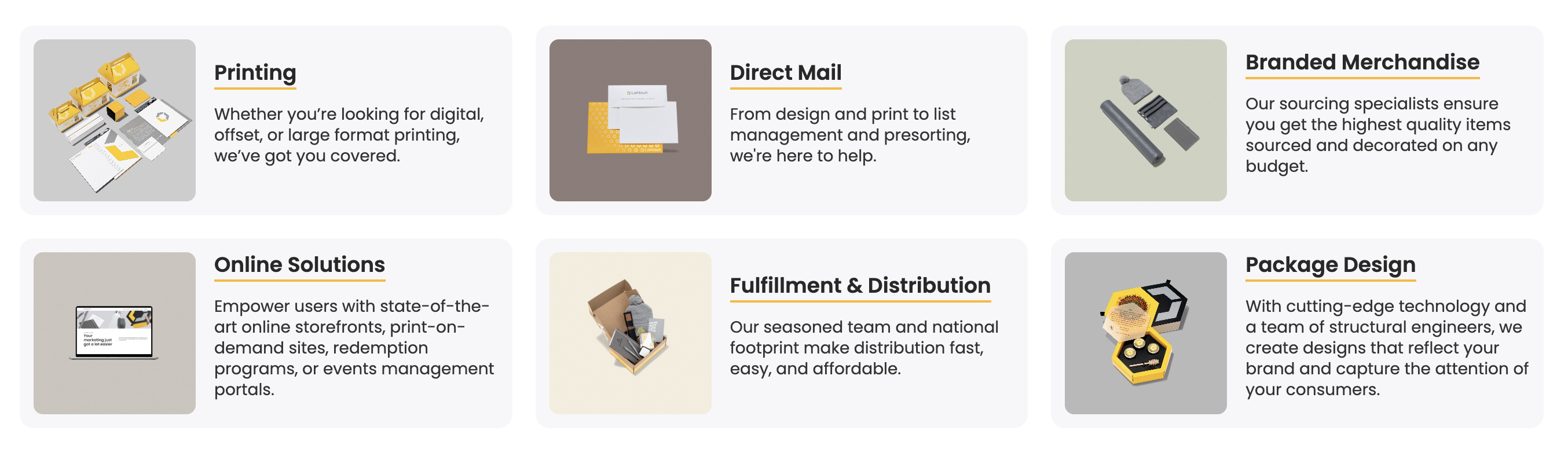
When print, branded merchandise, kitting, fulfillment, and direct mail all live under one roof — and through one contact — the entire campaign operates differently.
There's no briefing lag. No version-control breakdown. No "we need to loop in the other vendor" email chain. The people handling your event gifts are the same people who understand your brand standards, know your timelines, and already have your assets on file.
At Lahlouh, this is the infrastructure we've spent 45 years building. We have in-house print capabilities. A 30-year track record in branded merchandise and promo. Kitting and fulfillment operations designed to handle high-volume, time-sensitive launches. Online platforms that give your teams on-demand access to brand-approved assets. Direct mail that ties the physical and the digital together.
All in-house, all under one roof, all through one contact.
That phrase isn't a line we like to throw around — it's a structural fact. And for our clients, it translates to something concrete: fewer handoffs, faster turnarounds, tighter brand consistency, and the ability to respond quickly when a campaign needs to pivot.

The Omnichannel Advantage — and Why It Keeps Getting More Important
The industry conversation around omnichannel has been building for years. But what we're seeing now is that it's no longer aspirational — it's the expectation.
Today's buyers move across channels fluidly. They see a brand at a tradeshow, receive a follow-up mailer at their desk, find a piece of branded merchandise in a gift box three weeks later, and get a targeted direct mail piece right before Q4 planning. When those touchpoints feel like one cohesive experience — same voice, same visual identity, same quality — the brand impression compounds.
When they don't, it lands like a missed opportunity.
Research shows omnichannel campaigns can drive a 287% higher purchase rate than single-channel efforts.2 But the stat only holds when the execution is actually integrated. Pulling off a true omnichannel effort requires more than strategy. It requires execution. And execution gets exponentially harder when the pieces are coming from different places.
This is where the "all under one roof" model stops being a convenience and starts being a competitive advantage.
When we're producing your printed collateral, your event kits, your branded merchandise, and your direct mail — all at the same time, all with the same assets and the same brand standards — the campaign doesn't just look integrated. It is integrated. The consistency isn't a happy accident. It's a structural outcome of how we work.
Three Problems We Solve That You Might Not Realize Are Problems
1. The brand drift problem. Every vendor you add is another place where your brand standards have to be explained, enforced, and checked. Over time, small inconsistencies add up: a slightly different shade of blue here, a different paper weight there, a promotional item that looks like it came from a different company. When everything runs through one team who already knows your brand, drift doesn't happen.
2. The timeline collapse problem. Multi-vendor campaigns live or die by the slowest vendor in the chain. One delay ripples across the whole project. When fulfillment, print, and merchandise are coordinated internally, we control the critical path — and we can absorb the unexpected without passing the chaos upstream to you.
3. The accountability gap problem. When a campaign has five vendors, no one fully owns it. The print vendor isn't responsible for how the merchandise looks. The fulfillment partner isn't tracking whether the direct mail piece went out on time. Working with one partner means there's one team on the hook — and one team invested in making the whole thing work.
.jpg)
This Is Why We Built What We Built
Forty-five years in print didn't happen by accident. Neither did thirty years in branded merchandise. The infrastructure we've built — in-house production, a curated supplier network, kitting and fulfillment operations, online ordering platforms — reflects a long-standing belief that our clients shouldn't have to work harder just to get more done.
We look at the full picture so you don't have to.
The industry is catching up to what that means. The lines between print, promo, packaging, and fulfillment are blurring — because buyers never actually saw them as separate lines to begin with. They always wanted one partner who could execute across all of it.
That's what Lahlouh has always been. And it's what we'll keep building toward.
Ready to see what an integrated campaign looks like from one roof? Let's talk.
Sources:
¹ “ASI Show Pavilion Opens New Doors for Promo Suppliers and Printers at PRINTING United Expo," PI World / Promo Impressions, June 2026.
2"Omnichannel Statistics 2026," Capital One Shopping Research. capitaloneshopping.com/research/omnichannel-statistics/
.jpg)
.jpg)
%20(1).jpg)


